Category: Personal

Disgrace — Five Years on, Let’s Not Forget

Disgrace — Five Years on, Let’s Not Forget

It was five years today, on August 30, 2021, that the U.S.’s disgraceful exit from Afghanistan, dictated and overseen by former President Jell-O Joe Biden, occurred. It’s important to remember how we must never again put in power the kind of individuals who engineered such a disastrous and disgraceful pattern of actions. In retrospective, here is a redux of the piece I wrote then, at the time of the Afghanistan debacle. Obviously, there have been many changes since and the country is nominally in a much better position now than in 2021, but any gains made are tenuous at best, and if voters don’t turn out or again revert to electing the forces of chaos and decay, those gains could evaporate overnight. Let us not forget.

In a normal country in normal times, those responsible for such an enormous debacle as what those at the top in our country caused to happen in Afghanistan in recent weeks would resign in disgrace. And if they didn’t, steps would be taken by those charged with oversight to remove them from office, even try and punish them. But this is not a normal country and these are not normal times, and there seems to no longer exist any sense of shame, disgrace, or even admission of failure. Instead, as the alleged president just did, again, they take a victory lap and spew lies and distortions touting how brilliant and insightful they are, and hope everyone is as imbecilic and full of guile as they are.

Listening to Biden’s words a short while ago made me more angry than I can ever remember any political figure, in my entire life, make me. And that is saying something. I shouted out my anger, and I struck my head wondering how a single human being — as despicable and useless as this rotten excuse for a human being is — can be so profoundly stupid. And arrogant. Surely it has to be a team effort. And the ulterior motive a powerful one.

The insult I used as the title of my last piece on this subject — Ignorance With Impudence — barely touches the level of ignorance nor that of impudence put on full display today.

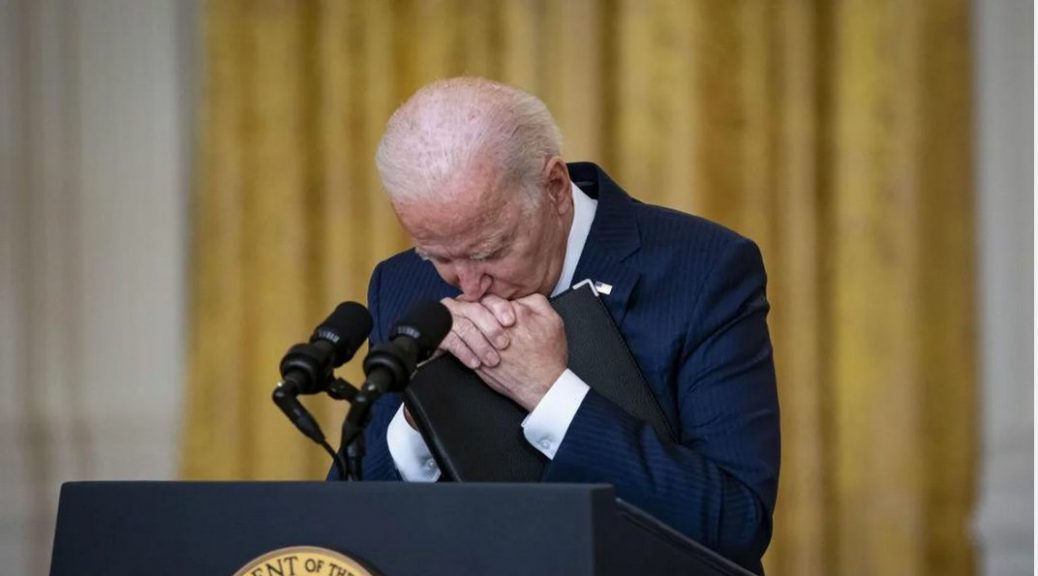
You see those hands in that photo above, showing a collapsing Biden last Thursday when he was challenged by Fox News’s Peter Doocy on his attempt to blame his Afghanistan catastrophe on his predecessor? Look carefully and you’ll see that they’re drenched in blood. The blood of 13 of our service people killed at Hamid Karzai International Airport last week. The blood of hundreds of needlessly dead Afghans in the same attack. The blood of the Americans, the blood of the Afghans who risked their lives to support us, deliberately left behind while surrounded by rabid terrorists intent on rooting them out and killing them. Also there is the blood of the hundreds, thousands, who will die in Afghanistan, in the United States, and elsewhere in the world as a result of the incredibly bone-headed and callous decisions made by this incompetent and those who allowed and facilitated him to make and carry them out.

If ever there was a time to say there is plenty of blame to go around, this is it. But since Biden is at the top of this heap of excrement and claims the buck stops with him — as if he actually means it, as Harry Truman did — he bears ultimate blame and responsibility for what happened, what will happen. To paraphrase the immortal 1988 words of Senator Lloyd Bentsen, back when Democrats still had some honor and a tad of sense, to vice presidential candidate Dan Quayle, Mr. President, I served with Harry Truman. I knew Harry Truman. Harry Truman was a friend of mine. Mr. President, you’re no Harry Truman.

Stalemate

Once more I find my post taking a different direction than I initially intended. The news continues to come in so fast, and it’s so awful, it’s impossible to keep up with it. I’m not a news service and this is not intended to be either daily reporting or a book. Any one with a fair mind and open eyes can see the reality, the actual events and people creating them, the results of those events and those people, and they don’t need me to continually point them out. My job, as I’ve executed it for more than four years now, is to put the pieces together, to analyze them, and to do what I can to bring people a clear view of the reality. To the extent many of my readers already have a clear view, they read my pieces and nod their heads and occasionally let me know they agree. And I try to give clear views to those readers who don’t see, or don’t want to see, the reality, and I hope I can bring some around to at least consider views other than those they are fed by what I’ve come to call the State Media, the corrupt and biased mainstream media and Big Tech whose lies and coverups in large part brought us to the terrible place we’re now at.

Initially I was going to call this piece Stalemate — the point in a chess match where a player has no legal moves left that won’t land his king in checkmate. It’s a draw, and the game is over. As a nation, we’re now in stalemate, and there are no legal moves left that will get us out of it. As a nation, we’re forced to live in this stasis, which was engineered by the Dem strategists and whoever is calling the shots behind the scenes of the party, and one has to hand them kudos for that achievement, as despicable and dangerous as it is. We have a clearly mentally incompetent president who, by almost any measure, the 25th Amendment was written for. But then, even if he could be removed from office either through that amendment or impeachment, we have a poison pill, the repulsive and dangerous Kamala Harris, as vice president. We get rid of the top guy, and we’re left with what might be an even worse substitute. And below her is the power hungry and vicious Nancy Pelosi. So, three layers deep, we’re left with no good legal moves, and that was the plan all along.

Those same Dem power brokers counted on what they see as the stupidity of the American people, for whom they have no respect other than to use them for their own purposes, and then along came the gift that keeps on giving — the COVID pandemic — which allowed them to flaunt and just plain throw out constitutional protections of our vote. That fraud allowed them to engineer a victory for a doddering old fool you wouldn’t trust to drive your kid’s school bus, let alone head the most powerful country on earth. And they knew that, even in his dementia, given the chance to grab the top accolade of his long and feckless political career — the presidency — Jello-O Joe would put the interest of the country aside and go for it. For this he won my top Profile in Cowardice award.

As I point out in that piece, it wasn’t always this way in American politics, even among the Democratic Party. Read the piece and see, if you forgot or weren’t around at that time, how Thomas Eagleton — a far more capable figure then Joe Biden — stepped down from being George McGovern’s running mate in 1972 when details of some issues with depression Eagleton had dealt with came out. At that time, the good of the country took precedence. That now seems like a prosaic concept.

An Unmitigated Disaster of a Presidency

For anyone who voted for Joe Biden — and, to be perfectly frank, you have to bear some responsibility for this debacle — I defy you to name one single thing Biden has done, one decision he’s made, that has made life better for ordinary Americans. I’ll go one further, and defy you to name one single thing, one single decision, he’s made, that hasn’t made things much worse for this country and its residents. We are so far beyond fucked at this point, it’s hard to even find a suitable word to describe it.

Whether it is throwing open our southwestern border to every ilk of criminal, drug runner, COVID-carrier, and terrorist who cares to cross it, in thorough disregard for our laws and well being — now being augmented by thousands of unvetted Afghans arriving and being sent willy-nilly around the country — taking our focus from competence and merit to attempting to inculcate divisions and distrust in our military, in our corporations and other institutions, and in society at large, to flaunting the Supreme Court and the rule of law to undermine the ability of property owners to pay their bills and stay afloat, to creating what can only be described as confusion on the coronavirus front, this president and his puppet masters have done what they can to sew discord and disorder in the nation. Crime is allowed to spiral out of control, unbridled federal spending is driving inflation, and he took us from energy independence to once more being dependent on the Middle East for our energy.

On the international stage, he has now shown this country to be weak and untrustworthy, and as we’ve learned, weakness breeds instability and tempts bad actors to take chances they would not otherwise. Despite the lies Biden told today — and there is no other word to describe his ridiculous and readily disprovable assertions — we have now created a terrorist nation in Afghanistan, and given a safe haven to not just the Taliban, but their close allies, al Qaeda, the Haqqani Network, and ISIS, among others. Even more mind-boggling, by leaving behind $83 billion in military hardware, we’ve made this terrorist state the fifth best equipped military in the world. The Taliban now have more Black Hawk helicopters, as just one example, than Australia.

Make no mistake. The same bunch of misguided idiots — Biden, Secretary of State Antony Blinken, Defense Secretary Lloyd Austin, child-moron Jake Sullivan who purports to be National Security Adviser, throw in Joint Chiefs Chairman and blowhard Mark Milley, and other members of the Obama foreign policy (sic) team — that brought us the ISIS caliphate in Syria and Iraq and the Iranian nuclear deal have now undone 20 years of progress, as difficult as it was, in Afghanistan, and created a mess and a threat that will be our nemesis for decades to come.

Perhaps most poignantly telling are the comments of the parents and spouses and siblings of the 13 slain service people, who spoke of Biden’s insensitivity, his self-absorption, his incessant talking about the death of his son Beau — who did not die in combat — his checking his watch each time, 13 times, a coffin came off the aircraft at Dover Air Force Base. I’ll end this piece with the words of Kathy McCollum, the mother of 20-year-old Marine Rylee James McCollum, killed in the attack on HKIA, who says it better than I ever could.

Calling in to a talk show Friday, McCollum said this:

“My son was one of the Marines who died yesterday. Twenty years and six months old — getting ready to come home from freaking Jordan to be with his wife and witness the birth of his son. And that feckless, dementia-ridden piece of crap just sent my son to die. I woke up at four o’clock this morning, two Marines at my door telling me my son was dead. So, to [have White House Press Babbler Jen Psaki on] right before me and listen to that piece of crap talk about diplomatic crap with frickin’ Taliban terrorists who just freakin’ blew up my son and no, nothing, to not say anything about, oh my god, I’m so sorry for families. So, my son is gone.”

McCollum’s son is gone. And as tragically, so is our national honor, and very possibly our security and our future with it.

Featured image, Biden’s Collapse, Al Drago, Bloomberg News via Getty Images. Used under Fair Use.

Stalemate, from rutrackerpulse.weebly.com. Used under Fair Use.

The Three Heads of the Poisonous Serpent, Jim Watson, Getty Images. Used under Fair Use.

This piece also appears in my Substack community, Issues That Matter. Please subscribe here, and there.
 

Back to the Moon!

Back to the Moon!

As long as it’s been since I’ve posted on this blog, it’s been way waaaayyyy longer since humankind has ventured past the bounds of low earth orbit into deep space. The last time was the flight of Apollo 17 which launched from Cape Canaveral — at the time, officially known as Cape Kennedy in honor of the assassinated president who set the nation on the path to the moon — on December 7, 1972, and returned to a splashdown in the Pacific Ocean on December 19, 12 days later but more than 53 years ago.

Two of the Apollo 17 astronauts, Gene Cernan and Harrison Schmitt, were the last humans to walk on the lunar surface, while their mission mate Ronald Evans orbited the moon in the command module. At least part of that history is to be added to now as the four crew members of the Artemis II mission hurtle toward the moon, escaping the grasp of earth’s gravity for the first time since the flight of Apollo 17.

There are naysayers today, just as there were in 1972, who question the value and purpose of the space program in general, and human space exploration in specific. My purpose in writing this essay isn’t to address those skeptics. There is ample evidence of the tangible value the space program has brought to both the U.S. and the larger world in the seven or eight decades it’s been a reality, and that evidence is easily uncovered. My answer to them is much simpler. We go into space, to the moon and points beyond, because it’s there. We don’t need any greater explanation or justification than that. It is in the human spirit to go beyond our known limits, our known frontiers, our known worlds, and space exploration captures and embodies and extends that spirit.

Back to the Cape

As a journalist who for some years covered the space program, I’ve spent a lot of time at the Cape and observing launches from both Kennedy Space Center and the Canaveral Air Force (now Space Force) Station. I can tell you from direct experience, seeing a launch on the tube or from a distance isn’t the same as being close up. I can see night launches, and occasional landings of SpaceX first stages, from my home, 120 miles (193 kms) distant, and even hear them, about 11 minutes later. But that’s not the same as being close-up to a rocket lifting off from the pad and heading for space.

I’ve become a bit complacent over the years and have only gone down to the Cape a few times since my career as a science and aerospace writer ended some decades ago. In truth, I almost didn’t go down for the launch of Artemis II (I was there when the initial launch of Artemis I was scrubbed shortly before launch time). It’s a bit of a trip, dealing with traffic and the crowds can be challenging, and the chances of a scrub all too real. As fate would have it, I had errands to run the day of the launch in Ocala, so I figured I was already part way there so decided in real time to just keep going. And that’s how I wound up on the shores of the Indian River in Titusville, directly opposite and just about nine miles from Pad 39A, where Artemis II was in final stages of preparation for launch.

It is always gratifying seeing the crowds of people who come from all over the country and, even more telling, all over the world, to see a launch. It’s especially gratifying seeing all the kids in the crowds, animated and excited as they await liftoff. One of the things that has struck me the most since the end of the Apollo program is how humankind waited and wondered throughout eons of history when a person might walk on the moon, and how whole generations have been born since that last human presence on the moon and were again relegated to waiting and wondering. And now these kids were again going to be able to see their dreams and wonderings realized.

My Personal Journey

My engagement with space and space travel goes back to my own childhood, growing up at the height of the Space Race in the 1950s and 1960s. I go into some depth on this in my piece Voyage to the Moon: My Personal Journey, posted in this space on the eve of the fiftieth anniversary of the first moon landing on July 20, 1969. That piece is as accurate and worth reading now as it was in 2019, and I strongly urge you to click on the link and read it. I won’t rehash all the detail included in that piece here.

That said, it is worth noting that, during my years covering the space program, I got to interview and in some cases hang out with half the guys who had walked on the moon. Most notable among them was Buzz Aldrin, second man to walk on the lunar surface, with whom I spent a few fun days palling around. Also notable, especially in light of the flight of Artemis II, was the time I spent with Walt Cunningham. Cunningham never walked on the moon, but he was part of the three-member crew of Apollo 7, the first manned mission of the Apollo program. That mission corresponds with Artemis II. The four Artemis astronauts — Mission Commander Reid Wiseman, Pilot Victor Glover, and Mission Specialists Christina Koch and Jeremy Hansen — won’t be walking on the moon, at least not on this mission. But they are the crew of the proof-of-concept mission that will lead to the first planned Artemis lunar landing in 2028. Unlike Apollo 7, which orbited the earth for nearly 11 days, in its 10-day mission Artemis II will travel to the moon, go around the back or “dark” side of the moon, and then sling-shot back for a return to earth. Its crew will have traveled further from earth than any other humans ever have.

The Launch

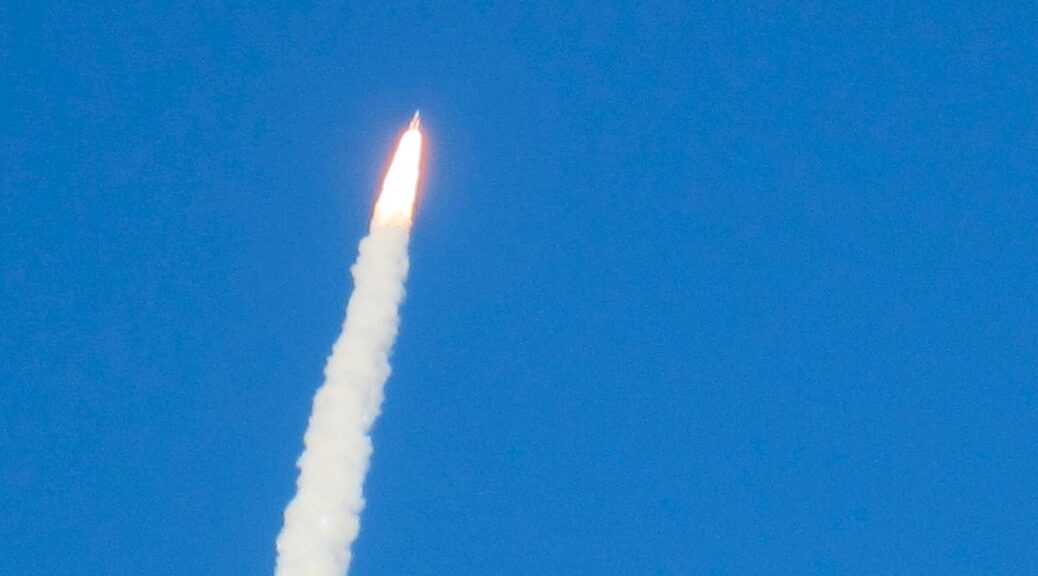
It is said that when the powerful Saturn V rockets which last sent humans to the moon lifted off, the sound waves broke windows in Titusville, the vantage point from which I was viewing the launch of Artemis II. Given the 8.8 million pounds of thrust, making Artemis the most powerful vehicle ever launched — 7.2 million pounds of thrust from the liquid-fueled main stage plus another 1.6 million pounds from the two solid rocket boosters latched onto the main stage — I fully expected sound waves at least equivalent to those generated by Saturn V’s 7.6 million pounds of liquid-fueled thrust. In truth, while I certainly heard the sound of the mighty rocket as it headed for space, I can’t say it was remarkable. Having witnessed many Space Shuttle launches, with their 6.4 million pounds of thrust, from the KSC press site — just three and a half miles from the launch pad — and feeling how those launches shook my insides, I expected more. Nevertheless, the liftoff was still a majestic moment, the sound of launch almost drowned out by the cheers and claps of the gathered crowds around me.

There had been a number of points in the last hours before launch, as I waited with the crowds and able to listen to the broadcast of a space group tracking the launch, when things looked iffy. There was the weather, which at times looked more than iffy. That fortunately improved toward launch time. There was a hangup closing and sealing the main hatch. It was found that a human hair was preventing the perfect seal needed, so that problem was corrected. There were high temperature readings with an onboard battery, and the mission management crew subsequently decided the readings were an instrumentation error and not a problem with the battery. Perhaps the biggest issue was with the Flight Termination System (FTS), a range problem. Flight controllers were unable to communicate with the system which would terminate the flight — read that as blow up the vehicle — were something to go wrong during ascent. At one point I was giving the chance of launch no more than 70%. To me, it’s always preferable, if there is to be a scrub, that it come sooner rather than later. In any case, finally, Shuttle-era gear was hauled out to deal with the FTS issue which resolved that problem. Things were looking better for launch.

Launch time — 6:24 p.m. EDT — came and went, with no launch. I had moved into position close to the shoreline where I could get a clear view of the launch site, through an opening in some bushes that would frame my photos, and waited, like everyone else. There was a Russian or Ukrainian family to my right, and their kids kept running back and forth in front of me on the rocks, a source of some annoyance. A number of different nationalities, mostly Asian and Latin, were to my left. There was a two-hour launch window, but I decided I’d give things 10 minutes before abandoning my post to see if I could learn the source of the holdup. Before that time tolled someone listening to a countdown report called out that launch would be in three minutes. I built in some time for a delay in the broadcast, which proved prescient since the vehicle ignited on the launch pad when the person was still calling out 30 seconds. Liftoff came about 10 minutes later than initially planned, but it was flawless as Artemis headed for space.

I won’t burden you with further verbiage about the launch. The pix and the videos that follow them below will tell you all you need to know and, if you didn’t have a chance to see the launch, wherever you are, you can share in it here. For now, three days in, things are going well with the mission, and if that trend continues we’re still on schedule for humans once more to set foot on the moon in about two years.

Click on the image links below for some videos of the launch. Here’s a hint: If you just click on the links, you probably won’t hear the sound of the launch. Instead, right click on each link, select “Save Link As,” and save the vids to your hard drive. Then view them with a video viewer such as VLC Media Player or Microsoft Media Player. Be sure your sound is turned up. It’s worth the slight trouble to hear the sound of the launch and of the crowd. Also, be sure to back click to get back to this post from the videos.

Alternatively, you can watch the vids, which play correctly with sound, on my Substack post. Just click on that link to go there.

All images and videos by the author.

This piece also appears on my Substack, Issues That Matter. Comment, share, and subscribe, here, and there.

A Grey November Afternoon

A Grey November Afternoon

This piece is a short story that initially appeared on my fiction blog, Stoned Cherry. It is part of my Growing Up New Jersey collection. I am posting it now since today is the 60th anniversary of the assassination of President John F. Kennedy, with which the story opens. That was November 22, 1963. A day to remember.

Well, that’s the kind of grey that November afternoon was, and we were let out of school early that particular Friday since that night was our school’s Military Ball, the big social event of the year. You got to understand that my high school wasn’t in New Jersey. It was in New York City on 15th Street and I commuted into the City every day, riding the PATH trains or the Erie-Lackawanna, which we called the Weary-Erie or the Weary-Lackatrains, wearing my uniform since it was a military school.

Anyway, we can talk about my high school later. The only important thing to know now was the afternoon was grey in that New Jersey November sort of way and I was home from school early. And I was locked out of my house because my parents were still at work and I didn’t have a key to the house. So here I was, locked out of my own house in my school military uniform, hanging out in the front yard on this November afternoon, when some of the local kids starting coming home from school. And they were coming home early, too, even though they didn’t have any Military Balls or anything to go to that night.

They were coming in groups of twos and threes, walking through the shortcut across the Laceys’ backyard, their school bags in hand, trooping along like kids let out of school do.

“What are you guys doing home so early?”

“Didn’ja hear about the President?”

“What about the President?”

“He’s been shot. They shot the President, and the Governor of Texas. The President’s dead. They told us about it at school and then they sent us home.”

“C’mon, really, what’s going on?”

“No, really. No kidding, President Kennedy was shot, and so was the Governor of Texas. No kidding. Kennedy’s dead.”

They say it’s one of those moments you always remember, like where you were when you heard about Pearl Harbor being attacked. Or where you were when Germany surrendered. Or, now, where you were and what you were doing when you learned that JFK had been assassinated. And I guess that’s true since I still remember it after all these years. And that’s where I was, in my front yard in Kearny, New Jersey, on a grey November afternoon, home early from school and locked out of my own house.

“Wow, man, I can’t believe it. That’s terrible. Do they know who did it?”

Little did I know that would be a question people would be asking for years after that grey November afternoon. But for the moment, I was in shock.

When John Kennedy ran for President, it was the first political campaign I took any interest in or probably was even aware of. Sure I knew we had a President, Ike and all. And Nixon was Vice President, Nixon who was running against Kennedy. But that was about it. Later on I learned my mother liked Adlai Stevenson, at least I think she did, but she never had any use for Truman after he dropped the Bomb on the Japanese. My Dad, who was a life-long Republican, didn’t adhere to that opinion, though, since he said it ended the war sooner and saved a lot of American lives.

Now even at the age of 10 I knew I wanted Kennedy to win. Part of it was that he was Catholic, the first Catholic to run for President, and of course the nuns in grade school all wanted him to win and told us why we should want him to win, which in the end came down to his being Catholic.

But for me it was more than that. He was young and appealing, and he had some good ideas, though I would have been hard-pressed to tell you exactly what they were. I even started wearing my hair like him, kind of puffy and combed over in front, in what was called “the Kennedy cut.”

And I actually got to see him, too. The March before the election I happened to be with my family in New York City when John Kennedy the candidate came out of Mass at St. Patrick’s Cathedral and waved at the crowd gathered across the street from the enormous, staid, grey Cathedral, and got into a black Cadillac limousine waiting by the curb. I actually got to see him, even snapped some pictures with a little black box camera I had, and for a 10-year-old Catholic boy from New Jersey, that was like the biggest thing that ever could have happened. And of course he was “my candidate” – I called him that, “my candidate” – and he just had to win.

Now I had a kind of bad track record with famous people. I got to see Pope Pius XII at the Vatican in Rome when I was 8, and then he upped and died a few months later. So much for that claim to fame. And in later years I killed off more than one Pope, got to see them at the Vatican or out at Castel Gandolfo and, bang, they’d die shortly afterwards. And now John Kennedy, my candidate who became my President, was dead, too, and I had seen him that March day at St. Patrick’s Cathedral.

So here I was out on the lawn on that grey November New Jersey afternoon as kid after kid trooped by, telling the same terrible story. The President, my President, was dead, and the Governor of Texas, Governor Connally, was wounded, and the Governor’s wife, too. Jackie wasn’t shot, though.

I was still in shock, and still locked out of my house, when Mrs. Allen came home. Mrs. Allen was our neighbor and her husband, Don, was our town clerk, which seemed like a very important office to me. And Mrs. Allen, Helen Allen, saw me out there and invited me into their house which was next door just up the hill from ours.

Mrs. Allen knew the gravity of the situation and must have thought how it was affecting me, and she turned on the TV in their living room and we both stood there and watched the news, both watched in silent disbelief, as Walter Cronkite related the details as they were known, in minute detail and in dribs and drabs as the reports came in from far-away Dallas.

Names that would become part of the history of that day began to filter in. Lee Harvey Oswald was believed to be the assassin. Officer Tippit was killed as he tried to apprehend Oswald outside some movie theater. Jackie Kennedy, alive but silenced, trying to flee the motorcade limousine as her husband was hit and slumped over. Lyndon Johnson, LBJ, who would become the next President to succeed JFK. There was little that Mrs. Allen and I said to one another or could say to one another as the reality came across the TV in black-and-white and tones of grey and sank into our consciousness.

And then suddenly my parents came home, late in the afternoon, while it was still light out. Both school teachers, they knew the news, had gotten out of school, and then went grocery shopping. Grocery shopping!

We heard the car arrive in our driveway, or they came to get me at the Allens’, I can’t really remember, but I was outside and in shock as much that they went grocery shopping as at what had just happened that afternoon in Dallas, Texas.

“Did’ja hear what happened? The President is dead and the Governor of Texas has been shot! Did’ja hear about it?”

I sounded like the kids who first broke the news to me, and I repeated the same unreal words.

“Grab a bag and help with the groceries!”

It was my father speaking, barking out an order in the annoyed, impatient way he had.

The groceries? The darned groceries? Is that what is important at this moment? More shock set it.

“Of course we heard about it. Now help get the groceries in the house.”

I don’t think I ever saw my father and mother the same way again after that, and a little later, the groceries in the house and the car trunk shut, that’s all I could think of as I stood there watching the news, this time in our living room, was how the groceries were more important to my father and my mother than that the President of the United States had just been shot and killed in Dallas. How could this be?

The big question now was whether the Military Ball would still be held tonight or canceled. And the decision, relayed through phone calls from the school and then from parent to parent, was made to go ahead with it since it was being held at the Waldorf-Astoria and the room and the entertainment had been reserved and paid for and it would be very difficult, if not impossible, to change everything now.

So now it was time to tear ourselves away from the somber news coming across the TV screen and to put on my dress uniform and get ready to pick up my date for the evening, my second cousin Patty Lynn.

I wasn’t much into girls yet, even at 13 and all, and as a freshman in an all-boys military commuter school I didn’t have anyone to ask to the Military Ball. So my parents came up with the idea of asking Patty Lynn to go with me to the Ball.

I actually hardly knew Patty Lynn, even though we lived in the same town, and it seemed a little odd to me to go out with my cousin, even a second cousin. She was okay, cute and nice enough and all that, but the real issue was that I was in the ninth grade, in high school, and Patty Lynn was still in the eighth grade, still in grade school. Or so my parents thought. As it turned out, Patty Lynn wasn’t in the eighth grade, which would have been bad enough. Oh, no. Patty Lynn, as I came to learn, was still in the seventh grade. I was going to my first high school Military Ball with a girl who wasn’t just my second cousin, but who was in the seventh grade!

And so we went, me in my dress blue uniform, Patty Lynn in her nice white dress-up gown, my parents and me in our car, Patty Lynn and her parents in their car, and we drove over to New York, through the long fluorescent tube of the Lincoln Tunnel, to Mid-Town Manhattan and the Waldorf-Astoria Hotel and the Military Ball which was, as one might expect, all a-twitter with talk of what had happened that day in Dallas.

I don’t remember how or why it got out, but it did get out that Patty Lynn was in the seventh grade, and from then on all I heard from my classmates was, “Eh-heh, Yacenda went to the Military Ball with a seventh grader! Eh-heh!” Again and again and again, for weeks if not months afterward. Oh, the ignominy! Oh, the humanity!

Patty Lynn and I actually had a kinda nice time at the Military Ball, and we even got away from our parents, all of whom sat around the big round white table cloth-covered tables talking about what had happened in Dallas, who was behind the assassination, who this Lee Harvey Oswald was, did he act alone, how this could happen, what would happen to the country, and I got to put to use the dance lessons I had to take at the Cotillion, mostly the fox trot, and Patty Lynn and I got to hang out some and enjoy each other’s company. But overhanging everything, besides the shooting of the President, was the thought that I was at the Military Ball with a seventh grader who also happened to be my cousin. And that and the taunting of my classmates for weeks afterward meant that I would never ask Patty Lynn out again.

Patty Lynn eventually grew from a slightly reticent and okay seventh grader into something of a very cute and attractive young woman. But by then it was too late, and years later when I happened to be back visiting home and we went to see Patty Lynn and her parents she was still living in that same town, was married to a fireman, had kids of her own, and was living what to me was this totally boring, uninspired fixed life. And I felt bad that I had let the fact that she was a seventh grader stop me from asking her out again and, ultimately, saving her from this dull, boring life, married to a fireman and living in some cramped little place in her folks’ house in that dull, boring town. But by then Jimmy Carter or somebody was President and it all came too late.

Sorry, Patty Lynn. And sorry, JFK.

Featured Image: JFK shot, one-sixth of a second after. Mary Ann Moorman/Wikimedia Commons. Used under Fair Use.

This piece also appears on my Substack, Issues That Matter. Read, share, and subscribe here and there.

That was then, this is now

That was then, this is now


AUTHOR’S NOTE: This is largely a personal account tracing my experience with events and dissent over the past 54 years, beginning with opposition to the Vietnam War and culminating with today’s anti-Israel and anti-Semitic demonstrations sweeping the country. I don’t pretend that it is a comprehensive view or account, which could easily take multiple book-length volumes. But it does give my perspective of the transition of attitudes and beliefs and ways of expressing dissent over those years until now.

I don’t think I’m in that photo above, but I could be. That was the line of protestors marching by the Executive Office Building in Washington on the night of Friday, November 14, 1969, in what was called the Death March, the prelude to the largest anti-war protest in U.S. history. Holding signs bearing the names of U.S. servicemen killed in Vietnam, it was a somber but dramatic demonstration of the reality of the war going on on the other side of the globe.

It was a cold and windy night, and we struggled to keep the candles we also bore, in little paper protective cones, from being blown out in the persistent breeze. The march began across the Potomac, near Arlington National Cemetery, and wound its way in single file across Memorial Bridge, past the Lincoln Memorial, along the National Mall, up 17th St. NW, past the Executive Office Building to Pennsylvania Ave., and then along the fence past the White House. We wondered whether President Richard Nixon was watching from an upstairs window in the White House as FBI or Secret Service agents made no effort to hide themselves as they shot photos of the demonstrators filing by.

It wasn’t our first brush with the FBI. Earlier that day, on the charter bus down from Rutgers University in New Brunswick, New Jersey, people — young people, not unlike us, claiming to be with the march organizers — came aboard at the toll booth on the Delaware Turnpike and told us there was no room in D.C. and we should turn back. We had a quick consultation and decided these were government agents trying to dissuade protestors from making their way to the capital and we should go on. And we did. And they were.

People had come from all over the country to make their voices heard. That was the night, waiting in the dark across the Potomac for the march to start, that I met Sally, still a friend today, and Anne, to become one of the loves of my life, and later their friend Norman, who with some other classmates had come from St. Louis to participate. The next day, filling the National Mall and spreading out beyond it, a mass of humanity — officially set at a half million people, but by our count closer to a million — protested the war. Peacefully. With decorum. With hope and determination. With a presence that could not be ignored. Though Nixon said he watched sports on television as the demonstration unfolded.

Later in the day, when the crowd had broken up and people began fading back into the fabric of the country from which they had come, there were a relative few demonstrators who resorted to violent protest and drew tear gas from the police. But as The New York Times reported, “The predominant event of the day was that of a great and peaceful army of dissent moving through the city.”

Non-violence in protection of an ROTC building

In March of the following year I drove out to St. Louis with a friend to visit Anne and Sally. Arriving late at night with a wounded car, we were greeted by scores of people running over a hill at Washington University shouting, “They’re beating heads! They’re beating heads!” It was a tense time, the anti-war sentiment running high, and in the coming days we got caught up in the swirling events that seized the campus. Along with listening to open-air speeches by leftist professors — to dispel any idea that leftism on college campuses is just a recent development, it was alive and spreading even in 1970 — we also found ourselves in nighttime demonstrations.

Anne and Sally were committed to non-violence, which coincided with my own beliefs while further reinforcing them. One night during our visit I found myself with my friends in a line of non-violent people standing between other demonstrators of a violent persuasion and the Air Force ROTC building they were intent on burning down. We succeeded in holding our line and saving the building, but all the time I wondered why I was putting my life at risk to save an ROTC building. Violence just seemed to me, as it still does, the wrong way to go about things.

The result of our efforts were short-lived and the building was burned a couple of months later, on May 5, 1970. Earlier, on the preceding Dec. 9, an attempt had been made to burn down the Army ROTC building on my own campus. And a more successful attempt at burning it down occurred a year after my graduation from Rutgers, on April 25, 1972.

I’m not going to pretend that all was peace and light at that time. Those were, indeed, exciting and dramatic times, even at my own college. And across the nation, there was the Weather Underground, with its Marxist orientation and goal of the violent overthrow of the U.S. government, and other radical groups committed to violence and domestic terrorism. Years later, Weather Underground leaders Bill Ayers and Bernadette Dohrn — indicted, and in Dohrn’s case convicted, for inciting riot and bombing government buildings, including the Pentagon and the U.S. Capitol — intersected with Barack Obama, who in 1995 launched his first Illinois state senatorial race at the Ayers-Dohrn home. Obama’s association with Ayers stretched over several years, and should tell you a lot of what you need to know about Obama.

“I don’t regret setting bombs,” an unrepentant Ayers told The New York Times in 2001, “I feel we didn’t do enough.”

“The traitor is dead!”

In the early 1980s I was in graduate school at the University of Florida. In my second year I was selected for a federal grant to study Africa, especially North Africa, and the Middle East, and also to study Arabic. Our Arabic instructor, whose name was Ilham, was Palestinian. On the day following the assassination of Egyptian President Anwar Sadat, as we settled into our seats in the classroom, we saw what Ilham had written in big chalk letters on the board: “Great news! The traitor is dead!”

I recall very well how shocked most of us were to see this on the board. Many of us exchanged uneasy glances around the room, unsure of how we should respond. If there was any enthusiasm for that shocking display of her views it was among the few Iranian students in the room. At the time I was mainly sympathetic to the Palestinian cause, but I also knew that assassination of Sadat, who had made peace with Israel and agreed to a framework both for peace in the region and resolution of the Palestinian issue, was not going to be positive for anyone. It also seemed outrageous that Ilham, a guest in our country, could make such a statement, with no attempt at discussion or persuasion. It was a pure statement of her hostility, even hatred, and prejudice, and in no way pedagogical.

I contrast our measured, and probably better informed, response then to the kind of mindless support for Hamas and hatred for Israel and Jews on campuses today, and I can see how both the realities and the nuances of one of history’s most complex conflicts have been lost on much of a generation that has simply lost both historical knowledge and perspective, as well as a moral compass.

Rejecting terrorism

Fast forward from 1981 to Sept. 11, 2001. The nation awoke to the biggest terrorist attack ever mounted on U.S. soil. It took just 19 terrorists to kill nearly 3,000 people in a few hours, bring down two of the country’s most iconic buildings and seriously damage a third, and reveal to the country both its vulnerability to terrorism and the ruthless and inhuman nature of those who choose terrorism as the means to making their point, whatever that point might be.

I was living in Greece at the time and word of the attacks came to me by way of a phone call from an Irish friend. My Algerian girlfriend at the time, later to become my wife, and I rushed upstairs to turn on the tube and watch, in horror, as the events of the day unfolded thousands of miles away. One thing that stuck in my mind was how Farida was as horrified as I was, and how she said, standing there staring at the screen, “If these are Muslims, I am no longer a Muslim.”

At the time I think most Americans, and probably most Muslims, shared a common abhorrence of terrorism and what it wreaked on Sept. 11. Probably more than we should have, as a country we were collectively willing to give up rights in a shared will to prevent further terrorist attacks. And as Spain and France and the U.K. and Jordan and Indonesia and other countries suffered attacks, we remained relatively unscathed in the decades that followed 9-11. But time, apparently, has a way of eroding memory, along with resolve.

On a personal note, with 9-11 receding into the rear view mirror, Farida — still a Muslim — later would ask me if I thought she was a terrorist since she would express support for the terrorist acts committed by Palestinians, of whose cause she was a huge supporter.

“No, I don’t think you’re a terrorist,” I’d tell her. “But you support what terrorists do.”

I think the same can be said for many of today’s demonstrators and others who openly express support for Hamas, one of the most ruthless terrorist organizations in the world, whose brutality is inflicted not just on Israelis but on its own people.

And this is now

I don’t claim that all college professors are as blatant in their anti-Semitic hatred and advocacy of violence as UC Davis’s Jemma Decristo is, but as recent events demonstrate, they’re more prevalent than one wants to think. And those professors, and in many cases administrators, have a major influence on the vulnerable and ill-informed young minds in their tutelage. And rather than adhering to the precepts of what education is supposed to be about — to “lead forth,” not to “cram down” — they exploit their positions of influence and trust to indoctrinate, not educate, their students.

I could excuse those students, but I don’t, and neither should you. Just as we, many of us, questioned the indoctrination that professors of earlier eras attempted on us, these students also can question that indoctrination today. As much as we might have been fond of Ilham and others like her, our values and knowledge transcended that affection to question when she attempted to cram down her particular view on us. This issue goes well beyond the instant issue of Israelis v. Palestinians, but reaches to the kinds of values these kids are taught at home, what they get from social media, the peer pressure they’re subject to, and a general lack of instruction in basic civic and social values. As I presented in my last piece, The ugly reality of American education, there is a pervasive crisis throughout the entire American educational system.

I’m sure growing up, as I did, imbued with the horrors of Nazism and the Holocaust, with half my extended family Jews who had experienced those horrors themselves, living in the New York Metropolitan Area and absorbing Jewish culture, I have a different view of anti-Semitism than many of these kids. But does one really have to have grown up with experiences such as mine to not know that prejudice and hatred of any sort is simply not acceptable? And what of adults who express the same kind of hatred? What can one say of them?

It was just 22 years ago that we recognized, on our own soil, the barbarity of terrorism and its infliction on innocent people. But somehow those sensibilities have been lost by many — even members of Congress — who now condone the murder and beheading of infants, the rape of girls and women, burning people alive, and kidnapping men, women, children, and even babies. What has short-circuited in these peoples’ brains? In their value systems? Is this the same process that took place in 1930s Germany, leading to the concentration camps and wholesale murder of millions, or in countless other societies, resulting in the most horrible barbarisms? Are we really at that point in contemporary America, or in numerous other countries formerly thought of as civilized around the globe?

In closing, let me say I am not unaware of various policy choices and implications that have shaped events and life on the ground in the Middle East. These are things I’ve lived with for most of half a century. There are legitimate arguments that can be made for different courses of action. Injustices have been committed, by both sides. And indeed, resolving the differences — as implausible as it seems at this moment — that have divided the Palestinians and the Jews for centuries is a matter of critical concern, if peace is ever to come to the region. But as long as hate and prejudice and violence are allowed to exist and to perpetrate themselves, no policy will ever succeed.

Featured image: Death Marchers pass Executive Office Building, Nov. 14, 1969, from Flickr, source unknown. Used under Fair Use.

National Moratorium, Washington, Nov. 15, 1969, from Flickr, source unknown. Used under Fair Use.

Assassination of Anwar Sadat, 1981, from rarehistoricalphotos.com, source unknown. Used under Fair Use.

Twin Towers Attacked, from the Los Angeles Times, Chao Soi Cheong, Associated Press. Used under Fair Use.

Hateful Tweet, from X, SRS-One. Used under Fair Use.

This piece also appears on my Substack, Issues That Matter. Read, share, and subscribe here and there.

Back at That Time of Year Again: Thoughts on “the Longest Day in the World”

Back at That Time of Year Again: Thoughts on “the Longest Day in the World”


It has become an annual ritual, on the Summer Solstice, that I repost this piece. It initially appeared six years ago, on June 21, 2017, the Summer Solstice in the Northern Hemisphere. I originally posted the piece on this blog, and subsequently it became an annual event to post it each year on June 21. Three years ago I began posting it on my fiction blog, Stoned Cherry. It now appears on both blogs and on my Substack, Issues That Matter. Today, June 21, 2023, it is once more the Summer Solstice, and the actual solstice officially occurs at 10:58 a.m. EDT/02:58 p.m. UTC. The time and other references and weather comments in the piece are as they were six years ago, when the post first appeared. It’s been five years since I lived on the boat, and there have been other changes. This year it has been 54 years, well more than half a century, since my father’s death, and Sunday was Father’s Day here in the U.S. I hope you enjoy the piece. And play the music at the end.

It’s June 21, the day of the summer solstice in the Northern Hemisphere, the winter solstice in the Southern Hemisphere. It’s a day that holds various meanings for different peoples, and its significance goes back millennia. The solstice, whether summer or winter, officially took place at 12:24 a.m. U.S. Eastern Daylight Time this morning, or 04:24 UTC.

Just to set the record straight and dispel any questions about my scientific knowledge, I know it’s not the longest day in the world. It’s the longest day of the year in the Northern Hemisphere, the shortest day in the Southern Hemisphere. But we’ll get to this a bit later.

It’s been a mixed bag today here on the West Coast of Florida. We’ve been having a lot of rain, something we didn’t have much of over the winter, and the rainy times are interspersed with sunny breaks. Right now, as I look out the window of my boat, the sun is mostly out but I’m looking at the light through rain-drop spattered glass. At least we’re not getting the effects of Tropical Storm Cindy, which is much further west and at this moment dumping lots of water on the upper Gulf Coast.

In this country, the summer solstice marks the official beginning of summer, though in other places and other cultures it marks the middle of summer, as indicated by the name Midsummer Night, which can occur anywhere from the 20th to the 24th of June. And really it is midsummer, since the days, which have been lengthening since the equinox three months ago, now will start to grow shorter, the nights longer.

The sun has reached its apogee in this hemisphere, as it stands today directly over the Tropic of Cancer. I feel summer ending, we already are on the downhill side, the side that will take us through the hot coming months but already on the slide back into winter, the cold time of year. Just as in the Southern Hemisphere the days will begin to grow longer as the seasons move back to summer.

A year ago on this day I was in Alaska, where there never really was a night. Where I was, well below the Arctic Circle, the sun went down sometime around midnight, but there was a kind of twilight that lasted until the sun rose again a few hours later. Above the Arctic Circle on this day, the sun never sets, and it truly is the Land of the Midnight Sun.

My thoughts turn to other things on this day. Someone asked me the other day, which was Father’s Day in the U.S., what thoughts I had of my father on that Sunday. But really, I think of Father’s Day as a commercial holiday. I also remember the last Father’s Day I had with my father, and how my mother did her unwitting best to create conflict between me and my father. While I may wish a happy day to the fathers I know on Father’s Day, it is today, the day of the solstice, that I think of my father. June 21 was his birthday, which in most years coincides with the solstice. I was told as a child that it was the longest day of the year, which I translated in my own way into it being the longest day in the world, and I would go around telling everyone who would listen that it was.

“It’s the longest day in the world!” I’d exclaim each year on his birthday, from morning until night.

I think today of my father on this day, the 21st of June. Gone now, for nearly 48 years. And I think back to the day of his birth, June 21, 1913. One hundred and four years ago. Even had he not died young as he did, just 56 years old, it is hard to imagine that he would still be alive today had he not died when he did. A prolongation of the inevitable.

A factoid I learned earlier is that today is not the longest day in the history of the world, as one might imagine it to be given that the earth’s rotation on its axis generally was slowing. Rather, the longest day in the history of the world is believed to be June 21, 1912, and things like the earth’s tides and recession of the glaciers have caused a slight increase in the rate of the planet’s rotation since then. My father was born a year later, which arguably could have been the second or third longest day in the history of the world, if not the actual longest day in the world.

I wonder what it was like on that June day, the day of the solstice, the longest day of the year, the day my father was born, in Jersey City, New Jersey. Did his father and mother, his Italian parents, my grandparents that I never knew, know it was the solstice? Did they even know of the solstice? Regardless, I’m inclined to think they did not think of it, if for no other reason than that they had something else on their mind that day. And then I think of the things people from then knew and were taught and how many of those things have been lost today, in these encroaching new Dark Ages in which we find ourselves, and I have to wonder. Perhaps they knew, better than most people today know. Or care to know. And they did note the auspicious day on which their son was born.

I’ll think of my father again on July 27, the anniversary of his death, and by then even our summer, the summer as we define it, will be half over.

The solstices, like the equinoxes, serve as a kind of punctuation for me. I watch the ebb and the flow of the days, the seasons, the years, and they mark the passage of time, time that increasingly slips by way too quickly. All of life is punctuation, I think. Slowing. Stopping. Breaking things, even waves on the water, into different parts, different pieces, different rhythms and fugues and movements and phrases and sentences. It is through such punctuation that we mark our lives, mark our transit through summer and back into winter, from day into night, from life into death. Watching, as a reader of a story does, while the time of our lives flows past. When we lose that punctuation, everything blends into one big mass, and we feel lost in the current, flailing and drowning as we’re pulled inexorably along. At least I do.

Enjoy this song, which I found today amid my files, and with which I end this post, and enjoy the time that nature and life give us.


Click here if song doesn’t play.